
Can Still Play!


Can Still Play! is a design research project exploring how play can strengthen connections across generations in public housing playgrounds. Grounded in the belief that play is a shared language across ages, the project investigates how everyday neighbourhood spaces can become opportunities for connection, participation, and community building.

Thesis question:
“How can existing public housing playgrounds limit or support intergenerational play? How might design respond to these conditions?”
The project began through observations of everyday life in a neighbourhood in Hougang, Singapore, where I spent time getting to know children, parents, and residents through MakanBersama communal dinners and weekly Playtime Activations held every Friday evening.
Through these regular engagements, I observed that while children were often actively engaged in play, many adults, particularly parents and caregivers, remained on the sidelines as observers.
Although playgrounds are designed as communal spaces, interactions across generations did not always happen naturally. This raised questions about how playground environments may unintentionally support or limit intergenerational interaction, and how design might respond to these everyday conditions.

Community Context
Hougang Avenue 3
The project began at Block 25, a rental block in Hougang Avenue 3, before gradually expanding into other parts of the neighbourhood. The area itself is socially diverse, with families, elderly residents, children, and community spaces such as the Hougang Community Centre shaping everyday life and interaction.
MakanBersama
MakanBersama is a social organisation that supports young adults with children by fostering the kampung spirit and creating opportunities for employment, growth, and mutual support. Through communal dinners, they encourage relationship-building and trust within the neighbourhood, believing that sharing a meal is about more than simply eating together.
Playtime Activation
As part of the MakanBersama thesis design lab, student volunteers, including myself, found that communal dinners alone were not enough to fully understand the neighbourhood and its dynamics. In response, we initiated weekly Playtime Activations to engage more directly with children and families through informal play, conversations, and activities within shared community spaces.
Key Insights:
1) Adults still want to play despite responsibility and tiredness.
2) Children want to play with the adults (parents, older siblings, caregivers, etc.)
3) There are hidden boundaries to playing together and play itself.
4) Through conflicts, parents are the first adults to step in.
Intergenerational play is broad and can involve many different age groups and relationships. To create a more focused entry point, Can Still Play! centres on parent-child interactions as a starting point for broader community connection.
Working closely with children and families in the neighbourhood, the project draws from games, stories, memories, and play behaviours shared directly by participants themselves. These community-led contributions became the foundation for a series of playful prompts and invitations designed to lower social barriers and encourage participation across ages.
Activity: Draw You! Draw Someone You Want to Play With!
Children drew themselves with someone beyond their usual friends, maybe parents or older siblings. Many chose fathers or siblings, revealing a desire for play that extends across generations and everyday family relationships.

Originally designed as a playful invitation, these paper humans became a collective artwork representing people in the community. While some children drew family members, others drew public figures or imagined companions, revealing whom they feel connected to. Activity: What Should We Play Here? Mat

An open prompt is placed within the playground, inviting children and adults to share memories, games, and ideas through drawing, writing, and conversation. Children shared the games they want to play today, while adults reflected on games they played growing up, creating conversations across generations.
Activity: Treasure hunt!

Designed as an invitation for parents and children to explore the neighbourhood together, this activity revealed invisible boundaries within the community. While some parents guided where children could or could not go, this time, children took the lead, turning the search into a playful competition.
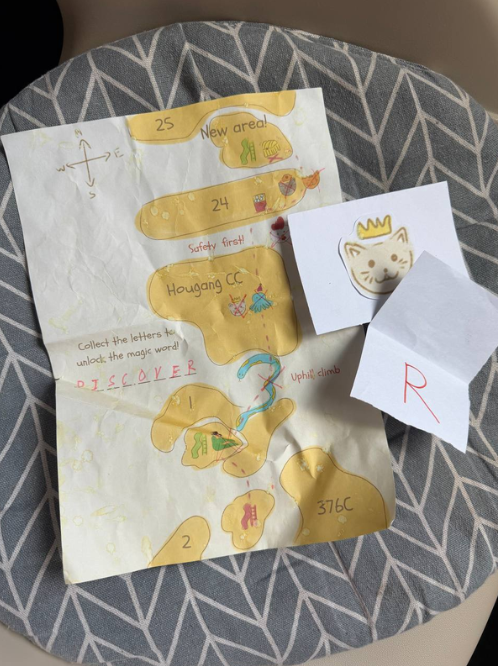
Activity: Treasure Hunt! (Children's Version)
Inspired by the original treasure hunt, children created one of their own. With only blank paper provided, they chose the treasure word, drew clues, and hid them within familiar spaces. This time, parents joined more actively, suggesting that child-led activities can invite adults to participate.

Can Still Play!
Game ideas foamboard
Inspired by games taught by children, remembered by parents, and gathered through community prompts, this foamboard invites people of all ages to rediscover and play together. Children were curious, read the prompts, and adapted the games as they played, creating their own rules along the way.

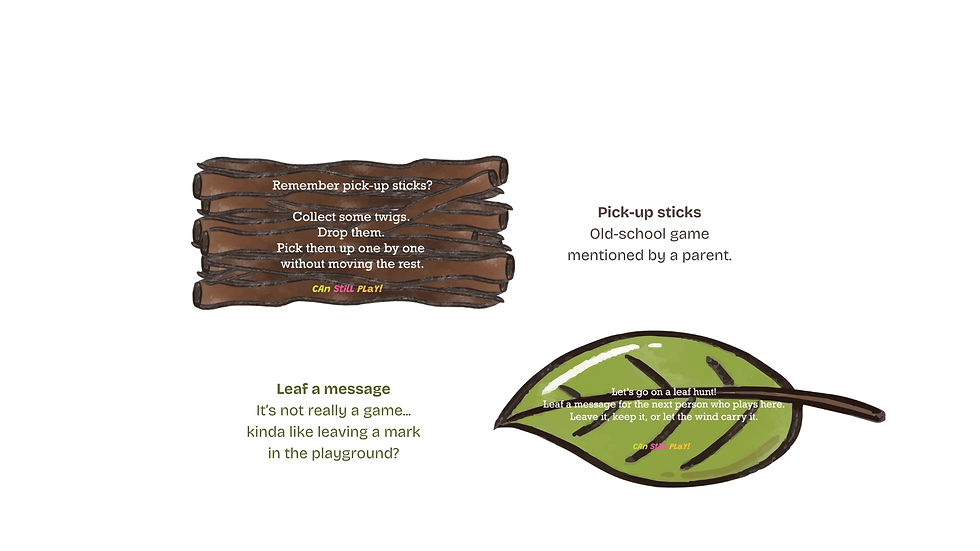
Playground Activity Cards
Developed through playground observations, these prompt cards respond to different energy levels, routines, and ways of participating. Designed with varying levels of engagement, they invited children and adults to reflect, initiate action, and share moments. Parents often paused, read, and joined at their own pace.


Comments